
Rosetta Core
Complete
General Cross-Language Comparison Framework
Reusable comparison framework for implementing identical programming tasks across multiple languages.
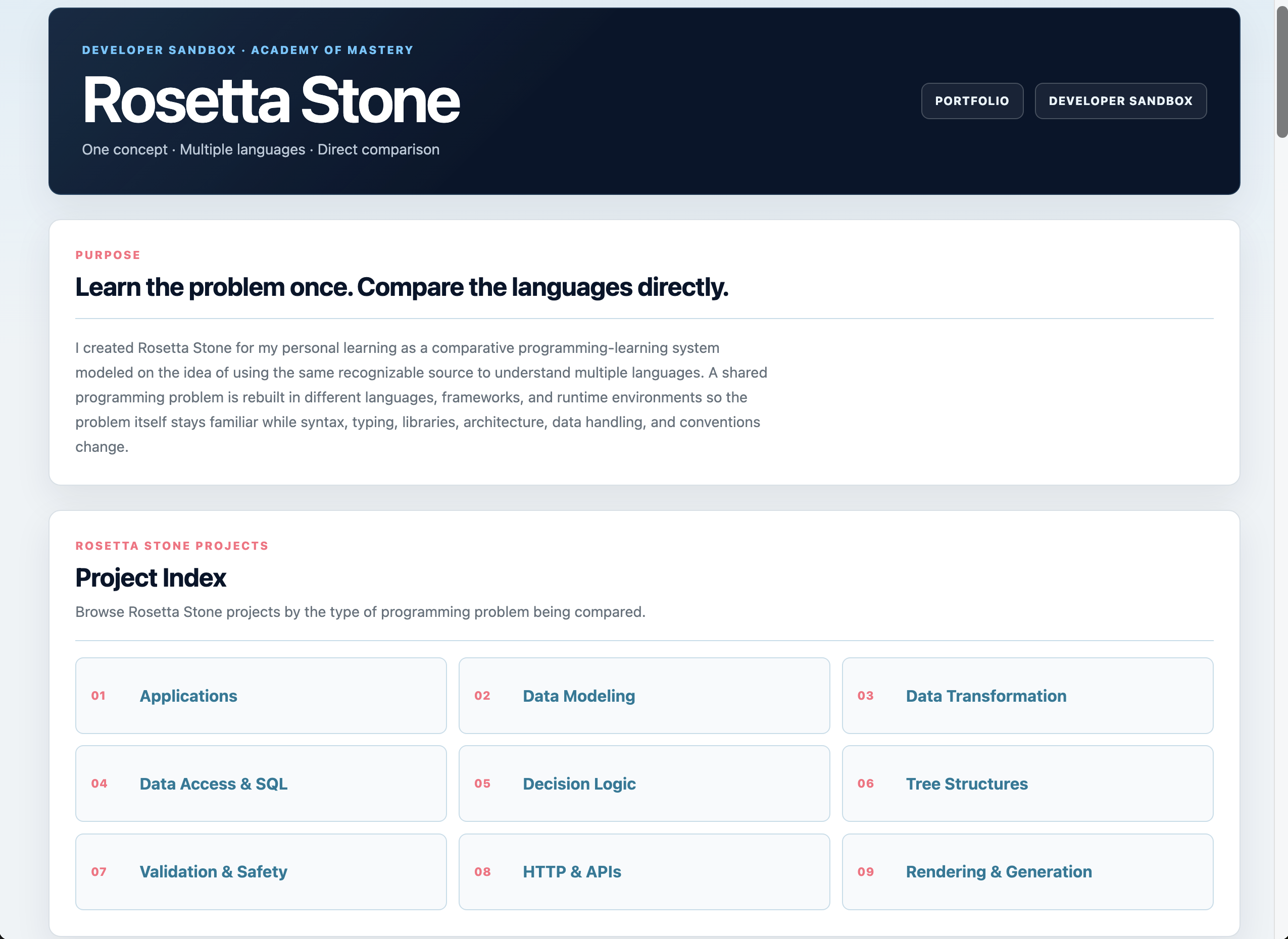
Rosetta Core
Use the concept od Rosetta Stones to learn a programming concept once, then rebuild the same problem in multiple languages/frameworks so you can compare syntax, typing, data structures, APIs, and conventions without relearning the underlying problem.
Build a growing catalog of completed Rosetta projects.
Technologies
Purpose & Learning Objectives
Purpose
Turn “Rosetta Stone” into a learning system and architecture for learning across languages.
Learning Objectives
- Hold the use case constant while changing implementation language.
- Display source and output side by side.
- Explain syntax and semantic differences rather than merely translating characters.
- Support browser and server-side languages without requiring every example to run publicly.
- Make shared concepts easy to compare across JavaScript, TypeScript, Python, PHP, and later languages.
Technology Plan
Current, planned, legacy, or candidate technologies for this project.Implementation Scope
Planned behaviors, architecture decisions, and evidence this project should produce.- Problem statement.
- Expected input/output.
- Implementations.
- Comparison notes.
- Equivalent data.
- Equivalent behavior.
- Equivalent visible result where practical.
- Show source.
- Capture static output.
- Document runtime commands.
- Data transformation.
- Requests.
- Validation.
- Collections.
- Classes/modules.
- File/data handling.
Project Notes
Implementation context, boundaries, and later expansion.Historical Principle
Like the Modern Agenda series, the learning value comes from equivalent meaning presented through different languages.
Relationship
Modern Agenda is the large application Rosetta; Rosetta Core handles smaller concept-sized comparisons.
Implementation Sketch
A compact structural example for this project.same input
same expected behavior
same output target
language A -> implementation
language B -> implementation
language C -> implementation
compare syntax + structure + runtime decisions